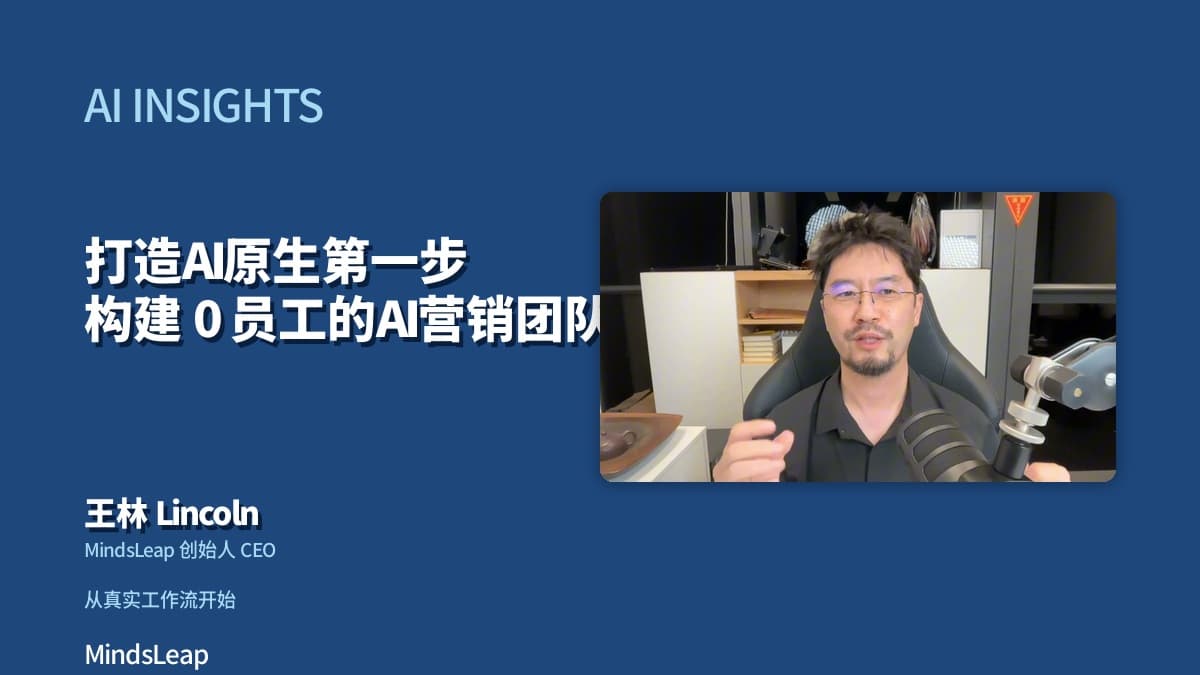
Author: Lincoln Wang | Founder of MindsLeap | Global Partner at Founders Space | Founder of Founders AI Club
This article was adapted by Lincoln from the MindsLeap AI Insights short video "The First Step Toward an AI-Native Organization: Building a Zero-Employee AI Marketing Team", published on September 2, 2026.
At MindsLeap, Lincoln Wang has been building an AI marketing team without hiring a dedicated marketing staff. The point is not to ask one chat tool for a few pieces of copy. It is to connect real work: website building, content research, editorial review, script development, video packaging, GEO-oriented distribution, and human approval.
Start with a real job
The first use case was a website. Instead of repeatedly explaining what the company was doing, Lincoln asked an Agent to help design, build, launch, and then maintain a site. The lesson was simple: future systems should not depend on one person for long-term manual maintenance. Ongoing updates need to be designed into the system from the start.
ContentHub creates a traceable editorial workflow
The next problem was keeping the site current. ContentHub assigns different roles to different Agents: one gathers relevant news, talks, and research; another reviews material against standards such as authenticity, timeliness, and communicability; an editor develops approved material into a draft; a publishing step waits for human review before anything goes live.
Automation does not remove accountability. Source material must remain traceable, and publication is a checkpoint where human judgment stays in the loop.
One source should be adapted, not copied
An approved source piece can be reorganized for Xiaohongshu, Zhihu, Baijiahao, Toutiao, WeChat, and other channels. Each audience needs a different structure and angle. This is also how Lincoln frames GEO: not keyword stuffing, but publishing sourced, structured material that can be understood and reused in different contexts.
From an idea to video, article, and audio
A video may begin as a note captured before sleep. An Agent retrieves relevant past material, helps turn the idea into a draft, and supports a spoken pass through a teleprompter workflow. The same approved content can then become vertical and horizontal video, an article, and an audio episode.
The goal is to let one good idea create value across multiple formats and platforms.
The hard part: Skills and orchestration
The challenge is not whether a single Agent can write or edit. It is turning small production details into reusable Skills and orchestrating multiple Agents around a workflow.
Subtitle timing and line breaks are a good example. If feedback such as “do not split a word across two subtitle cues” is not recorded in the system, a person has to fix the same defect repeatedly. When an 80-point output is corrected, the useful move is to tell the Agent what failed, why it failed, and how to avoid it next time. That feedback becomes a Private Eval and improves future work.
Keep people at the points that require judgment
An AI-native organization is not a conventional process with a few AI tools added on top. It redesigns collaboration among digital employees and between people and digital employees. People should not be the routing point for every task. Their job is to set goals, make taste and quality judgments, and approve final delivery. Repeatable, standardizable work can then move gradually to Agents.
For teams starting from zero, Lincoln’s recommendation is practical: do not plan dozens of Agents first. Start with one high-value, clearly defined, verifiable workflow. Make it stable, then extend upstream and downstream.
About MindsLeap
MindsLeap is an AI-native organizational transformation accelerator for entrepreneurs and companies. We help teams move from AI experimentation to real business outcomes through AI strategy diagnostics, founder second brains, digital employees, and FDE delivery.
This article was translated and adapted from the Chinese original with AI assistance.