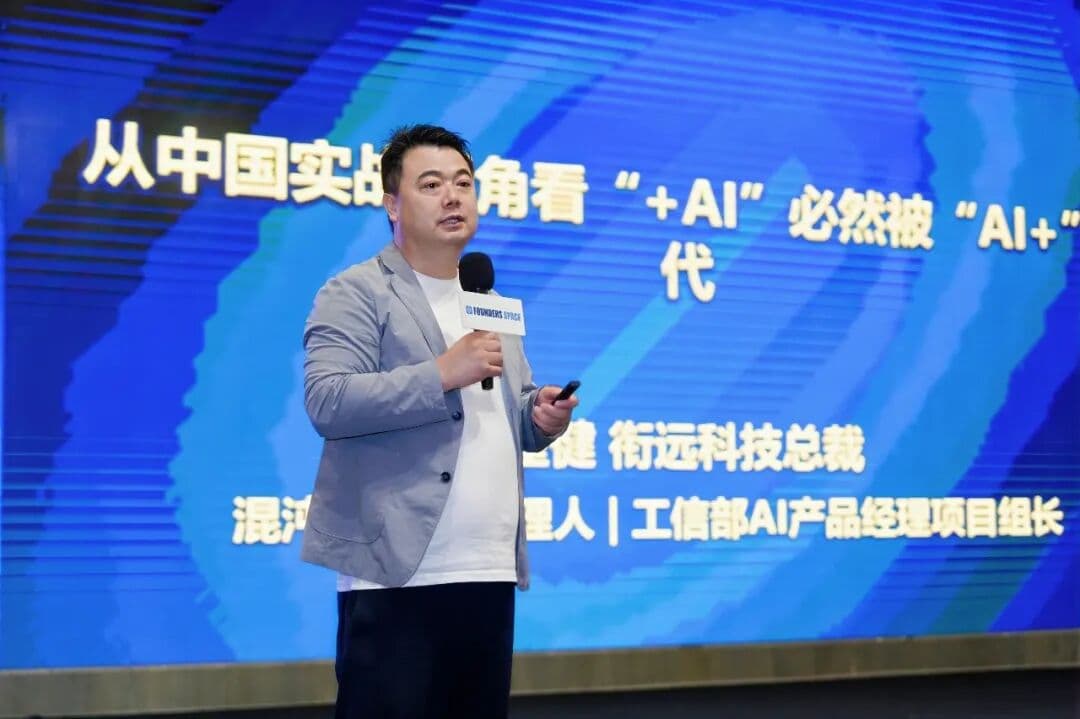
At the AI Native Enterprise Conference, Cui Jian, president of Xianyuan Group and an advocate for AI-native enterprise transformation, delivered a practical talk from the perspective of real enterprise implementation.
His core question was not how companies can use a few more AI tools. It was:
How can a traditional company truly become an AI-native enterprise?
The strength of Cui's talk was that it stayed close to business reality. He reminded entrepreneurs that AI-native transformation does not begin with a new organization chart or immediate employee replacement. It begins by finding new scenarios, new value, and new business models that AI can make possible, and then letting the organization evolve to support them.
An AI-native organization is the result, not the starting point
Cui began by correcting a common misconception. When people talk about AI-native organizations, they often think first about changing structures, roles, reporting lines, and headcount.
In Cui's view, that order is reversed.
Companies that have successfully used AI may indeed develop new organizational forms, but those organizational changes are the result, not the starting point. If traditional companies simply copy the visible result without first finding new ways to create value, organizational change can become superficial and may even reduce efficiency.
Cui's point was clear:
Before building an AI-native organization, a company must first become an AI-native enterprise.
In other words, a company should not redesign the organization first and then look for the business. It should first discover new business methods and new value creation methods, then allow structure to support them.
The real bottleneck is often the CEO's cognition
Cui argued that the biggest obstacle for many companies is not model capability or technical talent. It is whether the top decision-maker understands AI deeply enough.
Many chairpersons and CEOs do take AI seriously, but in practice they often assign AI to the CTO, CIO, or a senior executive while continuing to spend most of their own energy on existing orders, customer relationships, and legacy business systems.
Behind that behavior is a hidden assumption: AI is just a new technology.
Cui's judgment is the opposite:
AI is not only a new technology. It is also a new model.
Once AI is understood as a new model, the ownership of the transformation changes. A new model affects the business model, service process, revenue structure, customer relationship, and organizational design. These are not decisions that a technical department can make alone. They require direct involvement from the company's top leader.
The first curve pulls traditional companies back
Cui also warned that traditional companies face a strong pull from their first curve when they try to become AI-native.
That pull comes from the existing business model, existing processes, existing value network, and existing organizational mindset. The more mature, large, and successful a company is, the harder it can be to change, because past success keeps pulling the organization back to the old path.
AI-native transformation is therefore not about adding an AI patch to an old system. It is a long-term process of confronting the old system's resistance and rebuilding around new value, new models, and new organizational capacity.
Do not start by replacing employees
One of the most practical parts of Cui's talk was his view of where companies should start.
When building an AI strategy, he advised companies not to begin with tasks that both people and AI can do. Instead, they should first look for scenarios where:
- AI can do something people cannot do.
- People can do it, but not well.
- People can do it, but the cost is too high.
- People can do it, but service quality is unstable.
The deeper logic is that companies should first identify the productivity boundary of their industry.
If the entire industry has struggled to do something well, affordably, or consistently, and AI now makes it possible, then that scenario may contain a new competitive advantage. This is different from traditional cost reduction. It is not about using AI to repeat old work more cheaply. It is about using AI to create capabilities that did not previously exist.
From cheaper old work to new value
Cui cautioned companies against beginning with the question: "If I spend money on AI, how many people can it help me reduce?"
That question assumes that AI is simply a cheaper version of an existing employee. It narrows transformation into local efficiency improvement inside old workflows.
A more valuable approach is to let AI handle capabilities that were previously impossible, such as personalized service at scale, 24-hour continuous customer engagement, real-time updating and pricing, real-time omnichannel content generation, AI customer service, AI sales, and AI lead operations.
These are not simple substitutions. They open value spaces that were not available before. Once companies find these new capabilities, they are no longer merely optimizing old business. They are discovering new commercial territory.
A four-step path: build the new model first
Cui described a four-step path his team has developed through work with many companies.
The first step is to discover scenarios where AI can do what people cannot. Companies should not begin by circling old job descriptions. They should identify industry tasks that were previously impossible, too expensive, too unstable, or too difficult. This step is about finding the productivity boundary.
The second step is to determine whether these new capabilities can create new customer value. A scenario alone is not enough. The company must ask whether it can become a new service, a new product, or a value that customers could not previously receive.
The third step is business model upgrading. If the new capability truly creates customer value, the company should not simply insert it back into the old process. It should rethink pricing, delivery, and revenue logic, moving from selling tools to selling outcomes and from selling labor to selling output.
The fourth step is to build the native organization that supports the new model. By this point, the company has already discovered new value, new workflows, and a new business model. Organizational change is no longer abstract. It is designed to support the new growth logic that has already appeared.
This is why Cui emphasized:
An AI-native organization is the result, not the cause.
From selling tools to selling outcomes
Cui also discussed how AI is challenging traditional software and SaaS models.
In the past, many enterprise revenue models were built around projects, software subscriptions, and human services. In the AI era, a stronger model is emerging: charging directly for outcomes.
Companies may charge based on labor saved, new value created, or actual outputs produced. The biggest change is not the technology itself. It is the shift from selling tools to selling outcomes.
Once this shift works, organizational structure, revenue model, and customer relationships will all change with it.
The real reminder: upgrade, do not simply cut
Many companies begin AI conversations by focusing on layoffs. Cui's talk pointed in a different direction. He was not advocating crude replacement. He was outlining a clearer sequence for transformation:
- First, find the productivity boundary of the industry.
- Then determine whether AI can create new value.
- Next, upgrade the business model.
- Finally, let the organization support the new model.
If the talk were compressed into one sentence, it would be this:
Real AI transformation is not using AI to repeat old business more cheaply. It is using AI to create a new business that could not previously exist.
That is the most important takeaway for entrepreneurs. AI-native transformation should not begin with the question of how to replace people. It should begin with the question of what AI finally allows the company to do that was previously impossible.
MindsLeap x Founders Space will continue to host frontier AI conferences, practical AI workshops, and AI hackathons for entrepreneurs, helping business leaders turn AI cognition into real action.
Source Note
This article was adapted from the Founders Space official WeChat article 崔健|衔远集团总裁分享回顾, published on May 25, 2026.
About MindsLeap
MindsLeap is an enterprise AI transformation and AI-native startup acceleration platform. Through the MindsLeap Founders AI Club, AI training and strategic advisory, FDE implementation, startup acceleration, and global growth services, MindsLeap helps traditional enterprises embed AI into real business workflows and helps AI-native ventures connect with industry use cases and global markets. MindsLeap is a global partner of Founders Space.
This article was translated and adapted from the Chinese original with AI assistance.