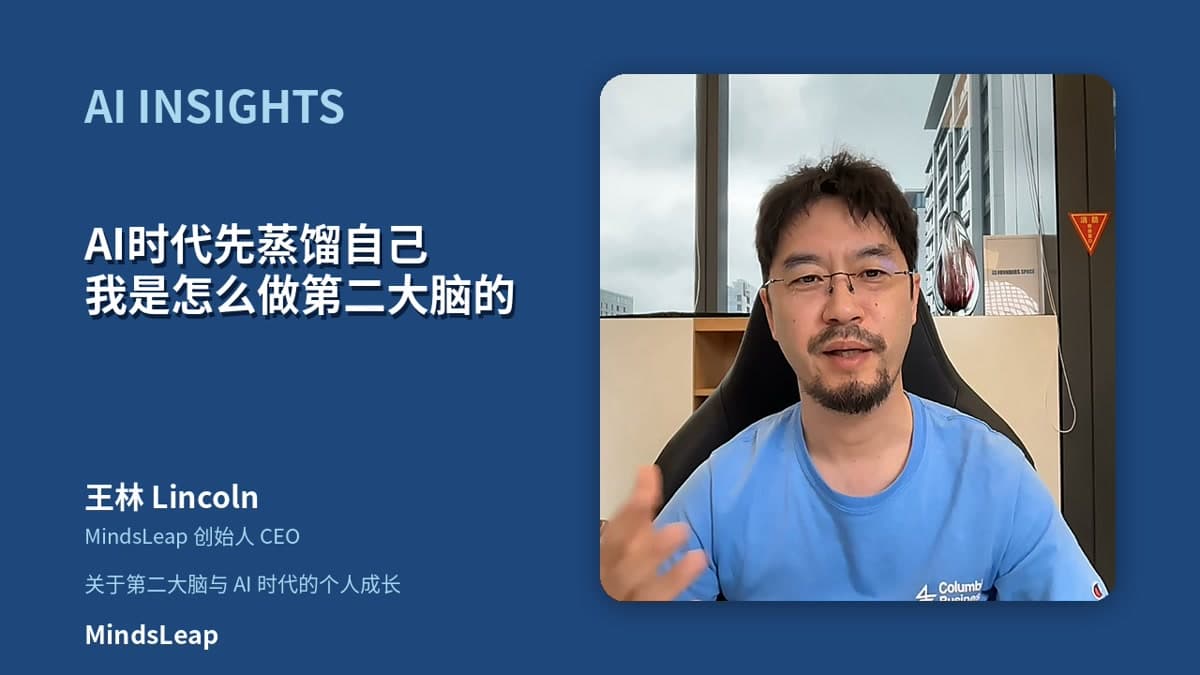
Author: Lincoln Wang | Founder of MindsLeap | Global Partner at Founders Space | Founder of Founders AI Club
This article was adapted by Lincoln from the MindsLeap AI Insights short video "Distill Yourself First in the AI Era: How I Am Building a Second Brain", published on August 12, 2026.
Recently, I have been working on a system that brings together my articles, talks, projects, relationships, and the judgment formed through those experiences. The goal is to make that context usable by AI without losing the human meaning behind it.
Many people describe this as building a digital human. I see an important difference between a digital human and a second brain.
A digital human can imitate your face, voice, and style of expression. A second brain should preserve something deeper: what you remember, how you understand a problem, what standards you use to make decisions, and how those standards change through experience.
A second brain is not a document dump
Putting a large number of files into a knowledge base does not automatically create understanding. An AI system may retrieve a passage without knowing why it matters, whether it has been confirmed, or whether it was only a temporary hypothesis.
The first question is therefore not how much information to store, but what information is trustworthy enough to keep. A useful memory should have a source, a time reference, a confirmation status, and a way to preserve later revisions.
I think of this as version control for personal experience. New information can extend an old judgment, but it should not silently overwrite it. Otherwise, more memory can make the system less reliable rather than more reliable.
My workflow begins with an Inbox for raw materials, spoken notes, meeting content, and work in progress. I then decide what should become stable long-term memory. This is not a one-time archive. It is a continuous process of deciding which information is temporary and which context I am willing to rely on over time.
Relationships are part of the context
Personal memory is not limited to documents. It also includes relationships.
I want to build a relationship wall that records not only who I know, but where we met, what we discussed, what they care about, what we have worked on, and in which situations the relationship may become relevant again.
That gives an AI system more than a name. It gives the context behind the relationship: why the person matters and where a future conversation might begin.
This is the difference between a contact list and a second brain. A contact list stores ways to reach someone. A second brain stores the meaning behind the relationship.
Two entrances: daily input and deep work
The long-term value of a system depends less on how sophisticated it looks than on whether information can enter with low friction.
I think about two connected entrances. One is designed for quick input and short-term memory. The other is designed for deep work and complex tasks.
When I encounter a new idea, a useful document, or an unexpected insight, I need a convenient place to capture it before it disappears. During deep work, an Agent should be able to retrieve the longer context around the task: what I am doing now, what I have done before, and how I usually make decisions.
Short-term information can then be filtered into long-term memory, while long-term memory remains available to real work. A second brain is not a static warehouse. It is a working system of input, retrieval, and revision.
The most important mechanism is feedback
The core of a second brain is not simply asking AI to remember more. It is allowing human judgment to flow back into the system.
AI can draft an answer, a plan, or a piece of content. I still need to decide what is correct, what needs revision, what sounds like me, and what should not be retained. Only confirmed results should become stronger context for future work.
The loop is simple: AI reads context and performs a task; a person reviews and corrects the result; the corrected result returns to the memory system. As this loop repeats, the Agent can learn my standards instead of repeating the average answer of a general model.
Without feedback, a second brain only accumulates material. With feedback, it begins to form a personal structure of judgment.
Models can change. Your context should remain yours.
Models will be updated, Agents will be replaced, and tools will change. A person's accumulated experience, relationships, standards, and values should not disappear with any particular tool.
That is why I want to build Digital Lincoln as a long-term system. It is not an avatar designed to look like me, and it is not an attempt to outsource every decision to AI. It is a way to gradually organize the context that has lived inside my head so it can continue to support new work.
In the AI era, an important personal asset is not only knowing how to use a model. It is having the discipline to distill your own experience and judgment, then make them available for continued use, correction, and growth.
The starting point is not finding the strongest tool. It is asking: which experiences are worth keeping, which judgments are truly mine, and am I willing to write new understanding back into the system after each real piece of work?
Distill yourself first in the AI era.
About MindsLeap
MindsLeap is an AI-native organizational transformation accelerator for entrepreneurs and companies. We help teams move from AI experimentation to real business outcomes through AI strategy diagnostics, founder second brains, digital employees, and FDE delivery.
This article was translated and adapted from the Chinese original with AI assistance.