Author: Lincoln Wang | Founder of MindsLeap | Global Partner at Founders Space | Founder of Founders AI Club
This article was interpreted by Lincoln based on the Dwarkesh Patel channel video "Dylan Patel – Two labs will soon control most of the world's workforce," published on August 25, 2026.
The core of this conversation is not simply how much electricity AI will consume.
The deeper issue is this: once a model company can turn a dollar of inference compute into several dollars of revenue, compute stops being just an infrastructure cost. It becomes a strategic resource that can compound.
Dwarkesh Patel and Dylan Patel record a podcast together every year. This time, Dylan Patel, founder of SemiAnalysis and one of the sharpest observers of chips, data centers, and AI infrastructure, was not talking about one model leaderboard or the release date of the next product. He was asking a more basic question: what happens to the economy when AI labs can convert compute directly into revenue?
Dylan's view is bold. He argues that more and more of the world economy will depend on the economics of AI labs and on where the compute market ultimately goes.
That sounds like an infrastructure question. It is actually a question about the future conditions for enterprise survival. If compute is no longer only a cost, but a productive asset that can increase in value through usage, then the companies that use compute more effectively will also have more capacity to buy the next batch of compute. The distance between leaders and latecomers may keep widening.
Compute Has Become a Strategic Resource
Dylan starts with a concrete estimate. According to his view, OpenAI began the year with roughly 2 gigawatts of compute, while Anthropic had less than 2 gigawatts. By the end of the year, both companies could exceed 5 gigawatts.
He goes further: he expects roughly 30 percent of this year's newly added compute to ultimately serve OpenAI and Anthropic. Next year, that share could rise to 40 or even 50 percent. This does not mean the labs will own every data center themselves. Much of the capacity may be built by cloud providers and rented to the labs. But the end customers paying for and consuming that compute would still be those labs.
These numbers are Dylan's market forecasts, not completed industry statistics. But they reveal an important direction. New compute is being allocated less by who wants to buy it, and more by who can convert it into greater revenue and therefore pay more for it.
This is different from the old software market. Software can be copied, and more servers can be built, but frontier model training and large-scale inference require high-performance chips, power, networking, and data centers. In the short term, supply cannot easily satisfy every buyer.
Compute markets are beginning to look a bit like financial markets. The competition is not only about how much resource you own today. It is about whether you can secure the next round of resource tomorrow.
Why Inference Cost Can Become Revenue
When Dylan explains lab economics, he gives a simple example: if inference compute costs 10 dollars and generates 50 dollars of revenue, the lab can reinvest the margin into more training.
The importance of this example is not whether that exact ratio applies to every model. It explains why leading labs can keep bidding higher.
If a company buys compute and receives only limited revenue from it, compute is a cost to control. If the company can turn the same compute into several times more revenue through better models, higher utilization, and stronger product distribution, compute becomes a growth engine.
At that point, training and inference are no longer two separate budgets. Inference produces revenue. Revenue funds the next training run. Better models increase product value. Product value creates more usage and more data. A loop begins to form.
Hardware efficiency can amplify the loop further. Dylan notes that newer systems may deliver several times more performance per watt. Even if power and data center costs remain high, each unit of energy can support more useful work.
That is why "compute is expensive" does not automatically mean "compute is not worth buying." The real question is: who can generate the most incremental value from one more unit of compute?
The Most Valuable Part of Compute Is Not the Chip
Another important point in the conversation is easy to miss. The economic value created by a fab or a data center may be far higher than the capital cost of building it.
Dylan uses a deliberately large estimate to illustrate the value amplification in the chain. The exact number should be treated carefully. The broader idea is what matters: chips are only the starting point. Value is realized only after they pass through model training, inference services, software products, and customer workflows.
This means the price of AI infrastructure will not be determined only by manufacturing cost. As long as downstream applications can earn higher returns, value will be redistributed along the supply chain. Chip companies, memory suppliers, cloud providers, and data center operators will all look at downstream profit and rethink how much of it they should capture.
Dylan describes this as a kind of bullwhip effect. One part of the chain raises prices first. Other parts do not adjust immediately. But as supply and demand rebalance, the pricing center of the entire chain moves upward.
For entrepreneurs, the reminder is direct. Do not look only at the procurement price of a technology. Look at how much value it can amplify across the full business chain. Buying an AI tool and building an AI workflow that continuously generates revenue are not the same thing.
The Model Company May Not Capture All the Value
Dwarkesh raises a critical question: will model companies eventually capture most of the value chain?
Dylan's answer is not a simple yes. His point is that much of the value created by models has not been captured by OpenAI or Anthropic so far. A lot of it still remains with users.
That distinction matters. Model companies provide intelligence, but the organizations that turn intelligence into profit may be trading firms, software companies, manufacturers, or teams that redesign workflows.
A company might spend a small amount on inference and turn it into much larger revenue through its own trading system, customer relationship, or business process.
So model company revenue is not the same as total AI-created value. The model is general infrastructure. Value capture happens when it is embedded into a specific context: does it change decision speed, reduce waiting time, or allow a smaller team to handle work that previously required a larger one?
This is where many companies misjudge AI. They think buying the best model means they already have AI capability. In reality, the model only raises the ceiling. Whether the company can reach that ceiling depends on its data, workflows, permissions, products, and organizational collaboration.
Why Meta and SpaceX Want Compute Optionality
The roles of Meta and SpaceX in the conversation are also interesting. They may not need to find an external customer before building compute.
If a company has a strong enough balance sheet, it can build the data center first and later decide whether to use it internally or rent it to OpenAI, Anthropic, or another lab. That gives the company a scarce option.
This is different from the model in which a cloud provider signs customer contracts first and then uses those contracts to finance construction. The player that must find a customer before building takes more construction risk. The player that can build first and wait for market pricing may gain more bargaining power when supply is tight.
AI competition is not happening only among model companies. Companies with capital, energy access, data centers, and internal application scenarios may also become key participants in the compute market. They can keep compute for themselves or sell it to the highest-value use case.
The next infrastructure competition may increasingly become a competition for optionality. It is not just about who has the most machines today. It is about who has the ability to switch among different demands tomorrow.
If AI Becomes Labor, Company Boundaries May Move
Toward the end of the conversation, the topic moves from compute markets to labor.
Dylan offers a provocative scenario. If frontier compute grows rapidly each year, and the compute required to reach the same capability keeps falling, then the "effective AI population" could expand much faster than the human population. Under certain assumptions, it is not impossible to imagine a single lab controlling an AI labor equivalent larger than the human population before the end of this decade.
That scenario depends on many assumptions that remain unproven. AI still cannot independently perform every job like a complete human worker. Compute growth cannot continue along one curve forever. But the question cannot be ignored: if most effective work output becomes concentrated in a few labs, how will the boundaries of companies and society change?
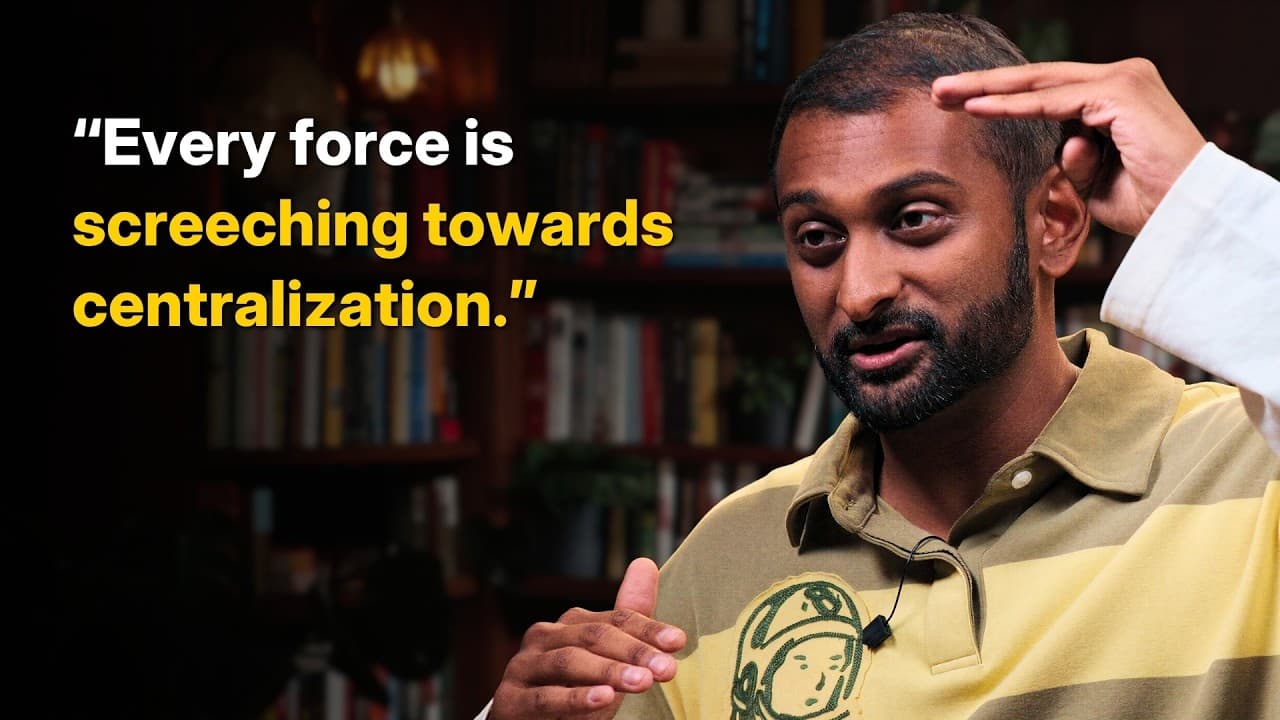
Dwarkesh notes that many forces seem to push AI toward centralization. Training has scale effects. The same capability can be amortized across billions of calls. Broad deployment creates more real feedback. If AI helps build the next generation of AI, the leader gains another recursive advantage.
That may be the most important point for entrepreneurs to remember. The future may concentrate not only model capability, but also the data, feedback, capital, and distribution around those models.
Companies Are Not Really Competing for More Compute
After listening to the conversation, what matters most to me is not whether Dylan's gigawatt forecasts turn out to be exactly right.
The more important question is this: as foundation models and infrastructure become more concentrated, what kind of competitive advantage can ordinary companies still build?
My answer is that companies do not necessarily need to own the most compute. But they must own the capability to turn compute into business results.
The same model can create completely different outcomes inside different organizations. One company attaches it to the outside of an old workflow and gets faster writing. Another company redesigns decision-making, delivery, and customer service, and may get a new operating model. The difference is not the model itself. The difference is whether the organization has turned AI agents into real units of work.
That means companies need to accumulate several kinds of assets again: judgment about customer problems, understanding of business processes, data that AI can use, and permission and feedback systems that allow humans and AI agents to collaborate.
These assets are less visible than chips. But they decide whether a company can extract unique returns from general model capability.
If compute does become concentrated in a few labs, companies should not place their hope on owning an equivalent foundation model. The real question is: once similar models are available to everyone, who knows where to place them, who can keep them working, and who can turn the results into organizational capability?
Dylan Patel's numbers are still forecasts. They may be affected by technical progress, capital costs, regulation, and market demand. They should not be treated as settled facts.
But the real value of this conversation is not one prediction. It lays out a full causal chain: more efficient models create more revenue; more revenue supports more compute; more compute pushes models and AI labor toward further concentration.
The question entrepreneurs need to answer is not whether they can catch the next model generation.
It is this: when everyone can use similar models, why can my organization produce higher value?
That answer will not live inside model parameters. It will live in how the company understands customers, redesigns workflows, and reorganizes work.
About MindsLeap
MindsLeap is an AI-native organization transformation platform for traditional enterprise AI transformation, AI-native companies, one-person companies, and technology founders. It connects industrial scenarios, capital, Silicon Valley resources, and global markets.
MindsLeap is a global partner of Silicon Valley innovation incubator Founders Space. Through the Founders AI Club, AI training, AI consulting, FDE (Forward Deployed Engineer) services, and startup acceleration, MindsLeap helps companies move from AI awareness to business implementation.
Around AI-native organization building, MindsLeap is developing an ecosystem that connects entrepreneurs, founders, AI engineers, industry experts, investors, and global innovation resources, helping organizations embed AI into business processes, organizational capabilities, product innovation, and growth systems.
This article was translated and adapted from the Chinese original with AI assistance.