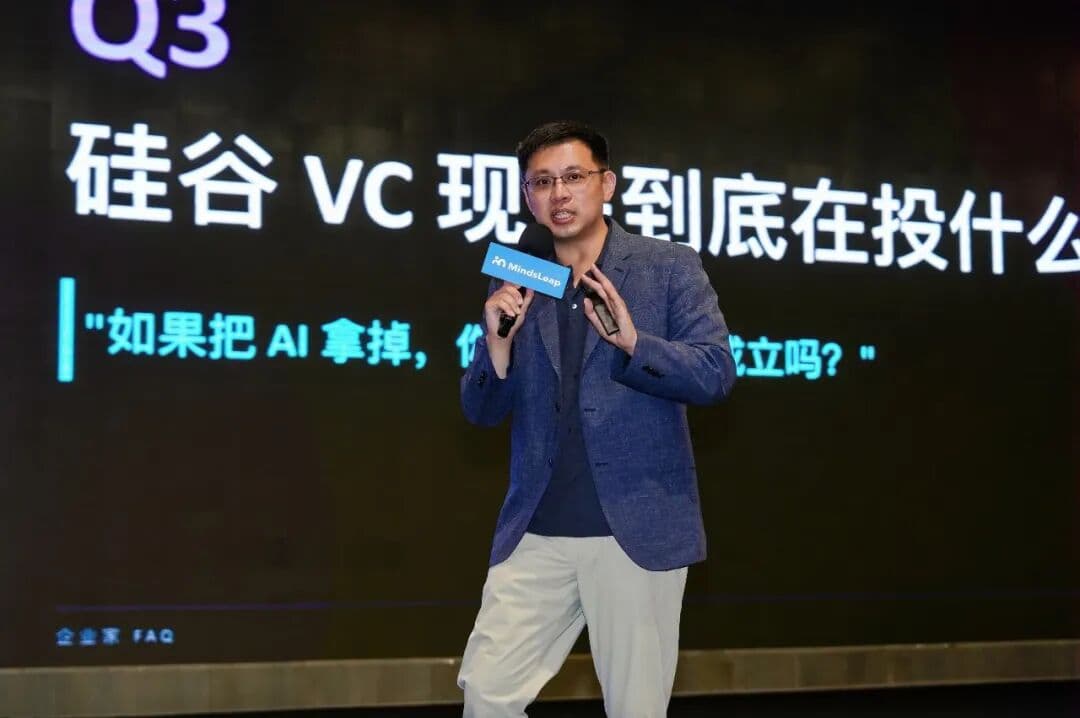
At the AI Native Enterprise Conference, Jeff Qian, former SVP at Plug and Play, Stanford entrepreneurship mentor, and co-founder of Spark Venture Studio, gave a structured talk on how Silicon Valley evaluates AI-native companies.
His talk addressed several questions entrepreneurs are asking now: Is AI replacing jobs, or specific functions inside jobs? Is it too late to start an AI company? Why are Silicon Valley investors and platforms increasingly drawn to AI-native startups? And how can a company know whether it is merely using AI tools or truly becoming AI-native?
Look at functions before job titles
Qian's first point was that companies should not begin by asking which jobs AI will replace. They should ask which functions AI will replace.
In his view, AI does not simply eliminate a profession as a whole. It breaks apart the standardized, low-judgment, coordination-heavy functions inside roles. The most exposed layer is often not the frontline worker or the final decision maker, but the middle layer that mainly passes information, coordinates tasks, and pushes processes forward.
When the core value of a role becomes forwarding, reminding, distributing, and aligning, that role becomes fragile in the AI era. Companies need to re-examine who is responsible for judgment, who executes, who transfers information, and which parts of the workflow should be redesigned around AI.
It is not too late to build in AI, but the method must change
Qian's view on timing was direct: it is not too late to start building in AI.
The reason is that many companies founded in the past three years have already reached significant valuation ranges in Silicon Valley. This is not merely another technology bubble. It is a signal that a new platform cycle has opened.
The question is no longer whether a company can enter the AI market. The question is whether it enters with old-company methods or AI-native methods. A company that still relies on traditional hiring, traditional departmental structures, and traditional software procurement may use many AI tools without actually becoming AI-native.
Why Silicon Valley likes AI-native companies
Qian said investors, cloud providers, platforms, and ecosystem partners are increasingly willing to support AI-native companies because these companies often share several traits: smaller teams, faster growth, lower marginal cost, faster product iteration, and stronger data feedback loops.
Platforms are not only looking at today's revenue. They are asking whether a team can use very few people to create extremely high productivity.
That is one of the biggest differences between AI-native companies and traditional digital companies. Traditional companies often solve complexity by adding people, processes, and systems. AI-native companies try to compress complexity through models, agents, automated workflows, and data feedback.
The real meaning of the eleven rules
Qian introduced a Silicon Valley-style framework for evaluating AI-native companies through team size, ARR per employee, and value density per person.
The point is not that every company must mechanically become a tiny team. The real message is that growth in the AI era should no longer default to headcount expansion.
Entrepreneurs need to ask new questions:
- How much revenue does each person truly unlock?
- How much of that revenue comes from AI-enabled productivity?
- How many roles in the organization merely maintain operations without creating high value?
- Can team members call AI, design workflows, connect AI into business systems, and amplify results with fewer resources?
In the AI era, productivity is no longer just about how much work one person completes. It is about how much AI and system capacity one person can orchestrate.
Five genes: mindset, metabolism, organs, evolution, and symbiosis
Qian described AI-native companies through five core genes: mindset, metabolism, organs, evolution, and symbiosis.
Mindset means that when a new task appears, the first question is whether AI can do it, rather than which person should be hired. Humans should remain in high-judgment, high-responsibility, high-relationship parts of the system.
Metabolism means building a company's own data feedback loop. If employees only use large models without turning feedback, interactions, and business data into internal system assets, the company has not built real AI capability.
Organs means the company is no longer simply a collection of departments. It becomes a collaboration network made of human workflows, agent workflows, data flows, and tool flows. The CEO's role shifts from managing people to orchestrating workflows.
Evolution means faster experimentation and iteration. AI makes prototypes, validation, content, and interface recomposition faster, enabling small teams to iterate at high frequency.
Symbiosis means companies cannot build AI in isolation. They need access to stronger platforms, capital, ecosystems, and founder networks. Competition in the AI era will increasingly happen between ecosystems, not only between individual companies.
Why the Firework AI example matters
Qian also discussed Firework AI as an example. The point was not only that it grew quickly, but that it reflects several traits of AI-native companies: starting from the question of how AI can improve customer outcomes, rather than what standard software can be sold; operating with a lean team; achieving high productivity per person; and growing faster than traditional companies.
The deeper change is in the founder's way of thinking. An AI-native team does not first ask whom to hire. It asks what AI and workflow can get the job done.
That was the center of Qian's talk: an AI-native company is not an old company made faster. It is a company running on a different operating system.
Five questions entrepreneurs can take away
For business leaders, the most useful takeaway is not a set of Silicon Valley terms, but a practical self-check:
- Which roles in the team mainly pass information?
- Has the company recalculated value per person?
- Does the company have its own data loop, or is it only feeding data into external platforms?
- Has the CEO started shifting from managing people to orchestrating workflows?
- How far is the company from the five genes of mindset, metabolism, organs, evolution, and symbiosis?
Qian's talk clarified an important trend: the core of an AI-native company is not knowing more about models. It is rewriting the relationship among people, processes, data, and organization earlier than others.
MindsLeap x Founders Space will continue to host frontier AI conferences, practical AI workshops, and AI hackathons for entrepreneurs, helping business leaders turn AI cognition into real action.
Source Note
This article was adapted from the Founders Space official WeChat article Jeff|前 Plug and Play SVP 分享回顾, published on May 25, 2026.
About MindsLeap
MindsLeap is an enterprise AI transformation and AI-native startup acceleration platform. Through the MindsLeap Founders AI Club, AI training and strategic advisory, FDE implementation, startup acceleration, and global growth services, MindsLeap helps traditional enterprises embed AI into real business workflows and helps AI-native ventures connect with industry use cases and global markets. MindsLeap is a global partner of Founders Space.
This article was translated and adapted from the Chinese original with AI assistance.