Author: Lincoln Wang | Founder & CEO, MindsLeap | Partner and CEO, Founders Space China | Founder, MindsLeap Founders AI Club
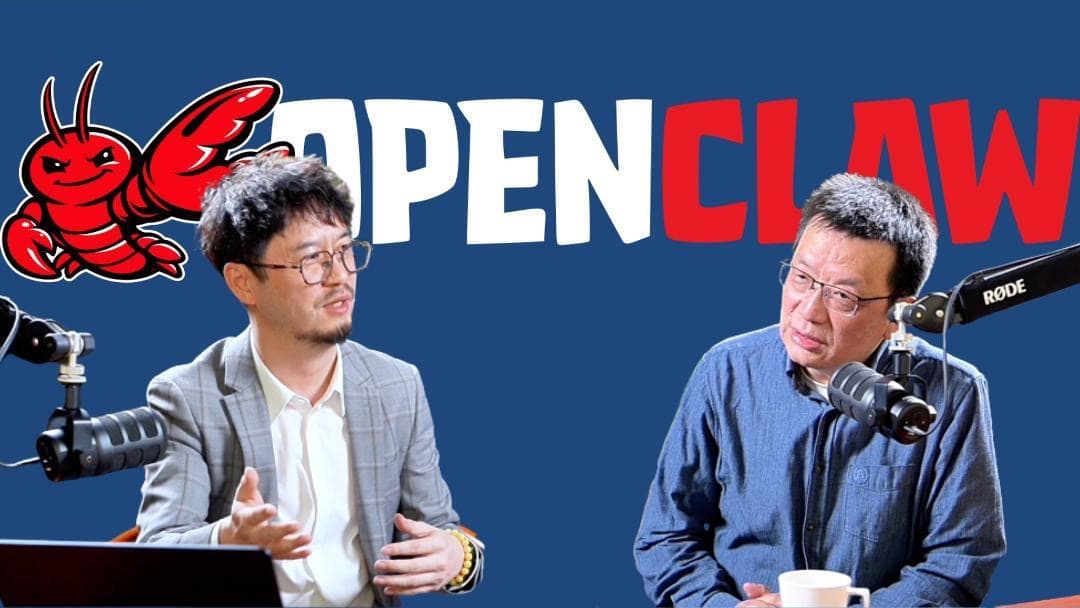
In this Founders Talk conversation, MindsLeap invited Jiang Yizhen to share his practical view of AI transformation.
Jiang is Chief AI Scientist at Youfu Network. He previously led Adobe's R&D team in Shanghai, served as CTO of Jujing Technology, and taught at Shanghai Jiao Tong University. His long experience across software engineering, AI agents, and enterprise technology transformation gives him a concrete, hands-on view of where AI is actually changing work.
The conversation did not stay at the surface level of "AI is powerful" or "tools are improving." It kept returning to a deeper question:
When AI becomes a digital worker that can be trained, directed, and evaluated, how should people and organizations change the way they work?
OpenClaw and "Raising Shrimp": Agents Need Cultivation
We began with OpenClaw, the agent ecosystem many Chinese users jokingly describe as "raising shrimp."
Jiang believes that whether a shrimp becomes useful depends not only on the model, but also on the curiosity and guidance of the person raising it. It is similar to educating a child: when it does something right, encourage it; when it makes a mistake, correct it; and throughout the process, keep giving it direction, rules, and memory.
That captures an important shift in AI agents.
Traditional software tools are bought and used. Today's agents are closer to digital partners that need continuous cultivation. They do not simply execute commands. They gradually adapt to a user's background, preferences, workflows, and skills.
Jiang pointed to several interesting ideas in OpenClaw: soul, user, memory, and skill. Users can define the agent's personality, tell it who they are, let it accumulate memory, and enable it to perform tasks through skills.
That is why the "raising" metaphor works. You are not just buying a tool. You are turning your methods, preferences, experience, and task system into context so that a digital worker can slowly learn how to work with you.
Technology Becomes Powerful When Users Shape It
Jiang emphasized that the value of OpenClaw is not only in the technology itself, but in putting agents into users' hands.
Technical people may look at it and say, "This is not that special." Non-technical users may discover its power precisely through use. That resembles the early internet: programmers could not fully predict what ordinary users would do with browsers, email, or short-video platforms.
If a technology stays only in developers' hands, its imagination is limited. When enough users touch it, they discover new scenarios, new skills, and new combinations.
That is why OpenClaw is worth watching as an ecosystem. Users contribute skills, security ideas, self-repair mechanisms, integrations with Feishu, smart homes, social platforms, stock information, and task management.
There are also risks. Jiang noted that malicious skills, permission boundaries, and user judgment will become important issues for agent ecosystems. But he is more optimistic about open ecosystems: with enough participation, communities and markets tend to create filtering mechanisms, and the useful parts survive.
From Vibe Coding to SPEC Driven: Software Cannot Rely Only on Feeling
When discussing AI coding, Jiang carefully separated several terms that are often mixed together: Vibe Coding, SPEC Driven Development, agentic coding, and Harness Coding.
Vibe Coding is attractive because you can chat with AI and quickly get a program. For small tools or small apps, it works well. The problem appears when projects grow. Code becomes difficult to maintain. Software is not only creative output; it is engineering. Engineering requires structure, requirements, design, and acceptance criteria.
That is why SPEC Driven Development matters. The core idea is to clearly explain what needs to be built, why it matters, how it will be evaluated, and what the design direction is.
Jiang made an important point: code itself often has lower information density than specifications. A product manager's two-page requirement may become 20,000 lines of code. In the AI era, the key is not whether the model can generate code quickly. The key is whether humans can describe requirements and acceptance criteria clearly.
This is also why Markdown becomes important. Jiang believes the future "programming language" may not be Java or C. It may be Markdown. Markdown is close to natural language, so people can read it; but it is also structured, so machines can understand it. It is becoming one of the most effective semi-structured languages between humans and AI.
Harness Coding: Direction and Evaluation Become the Human Role
Harness Coding pushes this shift further.
SPEC Driven still asks humans to think about requirements, design, and implementation. Harness Coding is closer to this: give AI a direction, tell it how the result will be evaluated, and allow the model to handle more of the design, implementation, and testing.
Jiang frames this as a management problem. AI is increasingly like a digital employee. When managing a digital employee, you cannot simply say, "Go do it," and stop caring. You must provide direction, and you must define acceptance criteria. Humans still own judgment, but they may no longer need to own every implementation detail.
This will strongly affect the software industry.
The traditional separation between product managers, architects, frontend engineers, backend engineers, QA, and operations existed because humans have limited learning and execution capacity. AI models are general-purpose information processors. They can write requirements, generate code, test, operate, and document.
The scarce human abilities may shift toward:
- Discovering real needs
- Describing goals clearly
- Defining acceptance criteria
- Judging whether AI's output actually solves the problem
This creates new opportunities for people outside traditional software backgrounds. Someone who understands business, users, and expression may be able to build useful software with AI even without reading every line of code.
Enterprise AI Transformation Is Organizational, Not Just Technical
Jiang has helped many companies with AI transformation. His view is direct: changing the technical team is often not the hardest part.
Programmers are used to learning new technology stacks, so introducing AI tools to engineering teams is not the biggest challenge. The harder part is organizational change. If a company wants to embrace AI, the CEO and leadership team must understand AI's capability boundaries. Future companies will not contain only human workers. They will also contain many agents, or digital workers.
Managing people and managing digital workers require different capabilities.
Jiang has observed two signs in teams that transform quickly.
First, managers begin to solve many problems with AI before turning to people. AI becomes the first layer of thinking, structuring, exploration, and verification.
Second, the whole organization starts using AI. Efficiency does not improve enough if only one person becomes faster. If one key node in a workflow refuses to use AI, that node becomes a slow channel. Everyone else may be moving at high speed, but the overall organization still slows down.
This is why Jiang emphasizes Markdown, Git, context, and version management. AI is familiar with software engineering workflows. If companies want AI to participate in collaboration, information needs to become more structured, traceable, and reusable.
Who Adapts Quickly, and Who Struggles
At the individual level, Jiang's observation is also practical: adaptation speed depends less on age or title, and more on openness.
Some young people adapt in two weeks because they are still in learning mode. Some experienced professionals are extremely valuable because they understand the company's business and are still willing to learn. They can combine old experience with new tools.
The hardest group is different: people who were historically very strong technically and are used to solving problems with their familiar "three axes." When AI does not work in the way they expect, they conclude that AI is bad, the code is ugly, or the path is not professional enough. But AI may solve the same problem using a completely different path.
This is not only a technical disagreement. It is a mindset issue.
In the AI era, the point is not to prove that one's old method remains correct forever. The point is to notice that new tools may solve problems in new ways. As Jiang put it, the other side may not be fighting with three axes anymore. It may have ten thousand axes, or it may not be using axes at all.
Traditional Companies: Stop Overthinking, Start Moving
For traditional companies, Jiang's advice is simple: do not stay in the thinking stage for too long. Start moving.
AI is not only for code. It can create proposals, presentations, market simulations, design drafts, pain-point analysis, and decision support. Even the most traditional company has information-processing work. If a company lists its pain points, AI can probably enter at least half of them.
The CEO needs first-hand experience.
They can use AI directly, or have a close assistant start first, but leadership must develop a feel for which tasks should go to people and which should first go to AI. The difference between AI and humans is that AI can work 24/7, run many roles in parallel, and experiment quickly at low cost.
That does not mean humans lose value. It means human value moves toward problem judgment, direction setting, context building, digital worker training, and integrating AI capability into real workflows.
Advice for Young People: AI Users and Non-AI Users Will Become Different People
For young people, Jiang's advice is direct: learn to harness AI.
People who can use AI and people who cannot will become two different groups. A young person who can raise agents, command a group of digital workers, and turn business problems into executable AI workflows may become valuable even to a more senior manager.
On OPC, or one person company, Jiang is cautiously optimistic. AI can give an individual access to capabilities that once required a technical team, product team, and execution team. But the hardest part of building a company is still business: why will customers pay? Where does the deal come from? Is the model real? AI does not automatically solve those questions.
So OPC is a real opportunity, but it requires strong general capability. AI makes it possible for one person to do much bigger things, but the people who succeed will still need business judgment, resource integration, customer understanding, and sustained action.
Final Thoughts
My conversation with Jiang Yizhen clarified one thing: AI transformation is not about installing a few tools, and it is not only about making programmers code faster.
It changes the way work itself is organized.
Individuals must learn to feed their experience, preferences, workflows, and judgment into AI, turning tools into digital workers. Teams must learn to organize collaboration through Markdown, Git, specifications, acceptance criteria, and context. Companies must learn to reassign roles between humans and agents so that communication, experimentation, and delivery can all move faster.
The central capability is not a single technical skill. It is harnessing.
Those who can ask better questions, describe goals clearly, define acceptance criteria, and judge whether AI output is truly useful will be more likely to occupy the next position of productivity in the AI era.
About Founders Talk
Founders Talk is an interview program created by Lincoln, founder of MindsLeap. It invites influential founders, entrepreneurs, AI experts, investors, creators, and global innovation practitioners in the AI era to discuss frontier technology, business models, enterprise AI transformation, and cross-market opportunities.
The program helps audiences understand global frontier technology trends and gain first-hand insight into enterprise AI transformation. Rather than only following headlines, Founders Talk focuses on lived experience, key judgments, and practical methods from people building and leading at the edge of change.
About MindsLeap
MindsLeap is an enterprise AI transformation and AI-native startup acceleration platform. Through the MindsLeap Founders AI Club, AI training and strategic advisory, FDE implementation, startup acceleration, and global growth services, MindsLeap helps traditional enterprises embed AI into real business workflows and helps AI-native ventures connect with industry use cases and global markets. MindsLeap is a global partner of Founders Space.
This article was translated and adapted from the Chinese original with AI assistance.