Author: Lincoln Wang | Founder & CEO, MindsLeap | Partner and CEO, Founders Space China | Founder, MindsLeap Founders AI Club
"The cost of building AI has never been lower. The ecosystem has collapsed, but the cost of keeping it running is an entirely different story."
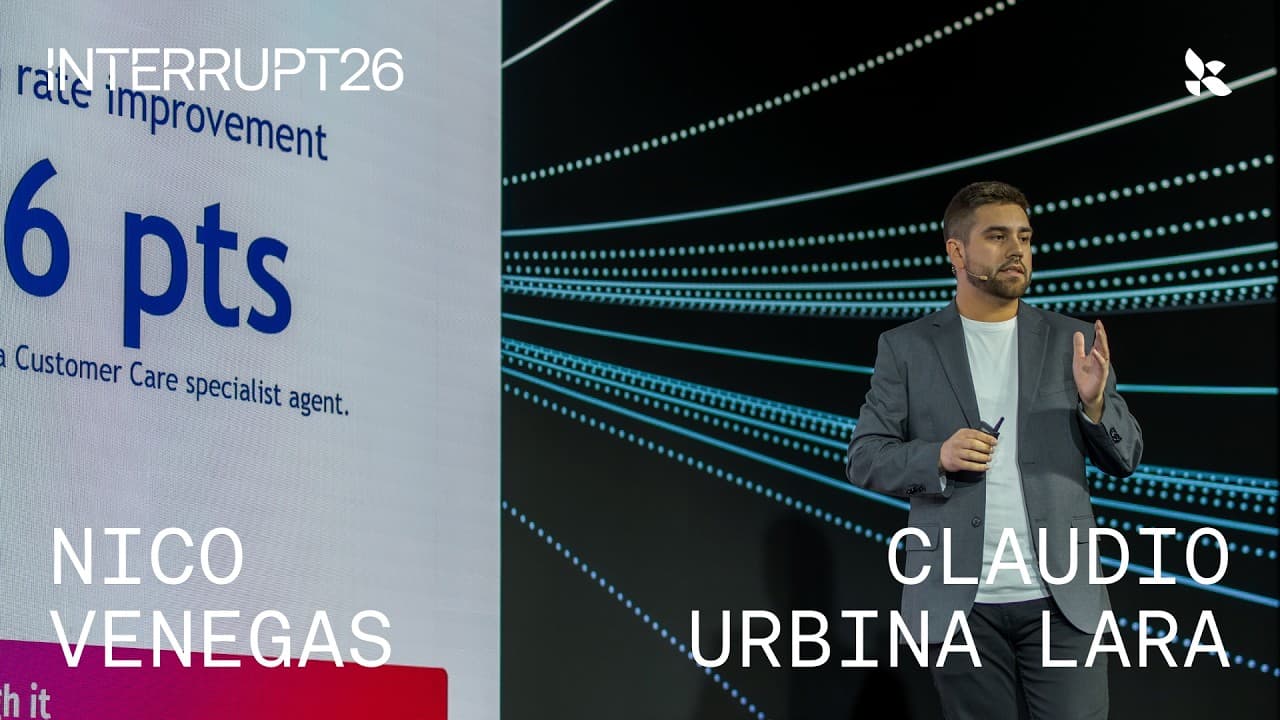
The person saying this is Nico, head of AI at LATAM, South America's largest airline. Standing on stage at LangChain Interrupt 2026, he didn't open with model selection or framework comparisons. Instead, he dropped two numbers: last year, LATAM carried 87 million passengers, and airline profit margins sit at just 3% to 5%.
Compare that to a SaaS company, where margins typically hover around 20%. An entire order of magnitude apart.
More critically, 31% of LATAM's operating costs go to jet fuel. And fuel prices doubled in the past year.
"In this industry, every dollar competes with jet fuel."
That sentence is the key to understanding everything LATAM does with AI.
Why an Airline's Conversations Are Worth Every Penny
Nico did the math for the audience: during the time of his talk alone, roughly 6,000 passengers were flying on LATAM. By the end of the presentation, their AI agents would have received thousands of interactions.
"We've been trying to answer one question: across all these conversations, what do we know that we don't know?"
This isn't a romantic question from a technologist. In an industry with 3% margins, every interaction either creates value or destroys it. There's no middle ground. LATAM's logic was direct: if you want to increase revenue without increasing costs, the only lever is to maximize every single interaction.
So they made a decision that seemed almost radical for an airline: deploy a consumer-facing AI agent inside their app, called LATAM Concierge.
The agent helps passengers plan trips, find flights, search hotels, and discover destination experiences. In the first month of beta, 52,000 users poured in. This made LATAM the first airline in Latin America to deploy an AI agent at this scale. Today, about 4,000 users interact with Concierge daily.
15% Waste Hidden in Every "Extra Step"
Technical lead Claudio took over and shared a detail about architectural evolution.
Concierge's underlying architecture is LangGraph, using a "super agent" pattern: a central supervisor doesn't do the work itself but dispatches tasks to specialized agents — flights, bookings, destinations, activities, insurance, customer service — each handling its own domain.
But the architecture didn't start this way.
Initially, LATAM used a "triage-and-handoff" model: a triage agent judged user intent, then passed control directly to the appropriate specialist agent, which handled the final structured output.
It worked well. Until they used LangSmith for deep observability and discovered a hidden efficiency black hole: every step was producing structured output. Measurements showed that this single habit alone caused about 15% waste in latency and token consumption.
The fix was restrained: keep the same agents, keep the same output quality, but change the flow so only the supervisor handles final formatting.
Same capabilities, same quality — 15% lower cost.
Claudio didn't frame this as a technical victory. What he said was: "When you live in an environment where every dollar competes with jet fuel, you're always looking for efficiency."
13% "Out-of-Scope" Conversations — And It's Not the Users' Fault
The second story is even more interesting.
LATAM found that 13% of messages sent to Concierge were classified as "out of context" — meaning outside the agent's designed service scope. The team's first reaction was predictable: users are testing the system, going off-topic, even asking Concierge to write Python code. Normal stuff.
But 13% was too high. They decided to dig into these conversations using LangSmith.
The result was surprising: 95% of the "out-of-scope" questions were genuine passenger needs. They were asking about check-in, baggage rules, LATAM Pass membership benefits, and special services.
The model wasn't wrong. The architecture wasn't wrong. The problem was simpler and more致命: they simply hadn't designed Concierge to handle these requests.
This year, LATAM connected a customer service agent. The "out-of-scope" message ratio dropped dramatically, and user return rates increased by 6.6 percentage points. Twelve percent of conversations now flow smoothly to the customer service agent.
The lesson is straightforward: only by deeply understanding what's actually happening inside your application — how information flows — can you solve problems like this.
When Conversations Become the Product
If the story stopped here, it would just be a technical talk about "how to optimize agents with LangChain and observability tools." But LATAM went one step further.
They built a platform called Compass. The core idea fits in one sentence: agents alone aren't enough. Conversations do have value — but only if you can extract structured signals from them at scale.
Compass feeds various unstructured data sources — UX research interviews, call center transcripts, agent conversation logs, even legal documents — into a pipeline: parsers convert data, mappers identify relationships (using Gemini Flash by default, Pro for complex ontologies), and modelers store everything in a BigQuery Graph knowledge graph.
They defined an "ontology" concept: it helps LLMs parse the different concepts and relationships in data.
Two examples illustrate its power.
One team previously used ChatGPT manually to process over a thousand UX research interviews, generating structured data into Google Sheets. After connecting to Compass, the workload compressed from weeks to days, with ontology coverage approaching 98%.
Another team was already confident in their legal contract parsing process — they had even validated it with business teams. But after running a comparison with Compass, Compass performed better. The team discovered the problem was that the business's definition of "what's important information" was itself biased.
Nico closed with a line every entrepreneur should chew on:
"When you have millions of interactions with passengers, the chatbot or agent is no longer the product. The product is the wisdom and opportunity you extract from all those interactions."
The Flywheel Isn't a Concept — It's Forced by Constraints
LATAM's entire AI system now forms a closed loop: millions of passenger interactions generate data, observability tools reveal what works and what doesn't, Compass extracts structured signals, and analytical capabilities feed back to optimize the running agents.
This flywheel wasn't dreamed up in a strategy session — it was forced by 3% to 5% profit margins.
"These constraints aren't disadvantages. We believe it's precisely these constraints that forced us to create something truly powerful today — the cost of processing one document is just one cent."
Nico offered three judgments:
AI has indeed become very cheap, but operating it at scale in a highly regulated industry — where mistakes have consequences — that's where the real value lies.
The next analytics bottleneck isn't compute — it's the ability to acquire and process unstructured data.
When an agent carries millions of interactions, it's no longer a feature — it's a mirror, reflecting what customers truly need, care about, and are willing to pay for.
A Reminder for Enterprises Everywhere
LATAM's story is easy to read in two extremes: either "airlines are building AI agents, we need to keep up" or "they have a five-year self-built platform called Cosmos, we can't replicate that."
Both miss the point.
What LATAM truly got right wasn't choosing a particular framework or building an impressive platform — it was embedding the observability layer into the system from day one. "We put LangSmith in as the observability layer from day one, and precisely because of that, we were able to iterate on the architecture."
No observability, no data. No data, no ability to discover problems from 15% waste or uncover real needs from 13% "out-of-scope" conversations. The flywheel can't turn.
For entrepreneurs everywhere, the signal from LATAM isn't "rush to deploy agents." It's "first figure out what your dollars are competing against" and "can your current system tell you what's hiding in user conversations that you don't yet know about."
That question has nothing to do with whether your margins are 3% or 20%. It has everything to do with what industry you're in.
About MindsLeap
MindsLeap is an AI-native enterprise transformation accelerator.
We partner closely with Founders Space, the Silicon Valley innovation incubator, to continuously connect cutting-edge global AI knowledge, the Silicon Valley tech startup ecosystem, and the real-world transformation challenges facing Chinese entrepreneurs.
Around the theme of AI-native organization building, MindsLeap is constructing an ecosystem for entrepreneurs, startup founders, AI engineers, industry experts, and investors — helping enterprises move AI from awareness, strategy, and tools into real organizational capabilities, business processes, product innovation, and growth systems.
This article was translated and adapted from the Chinese original with AI assistance.