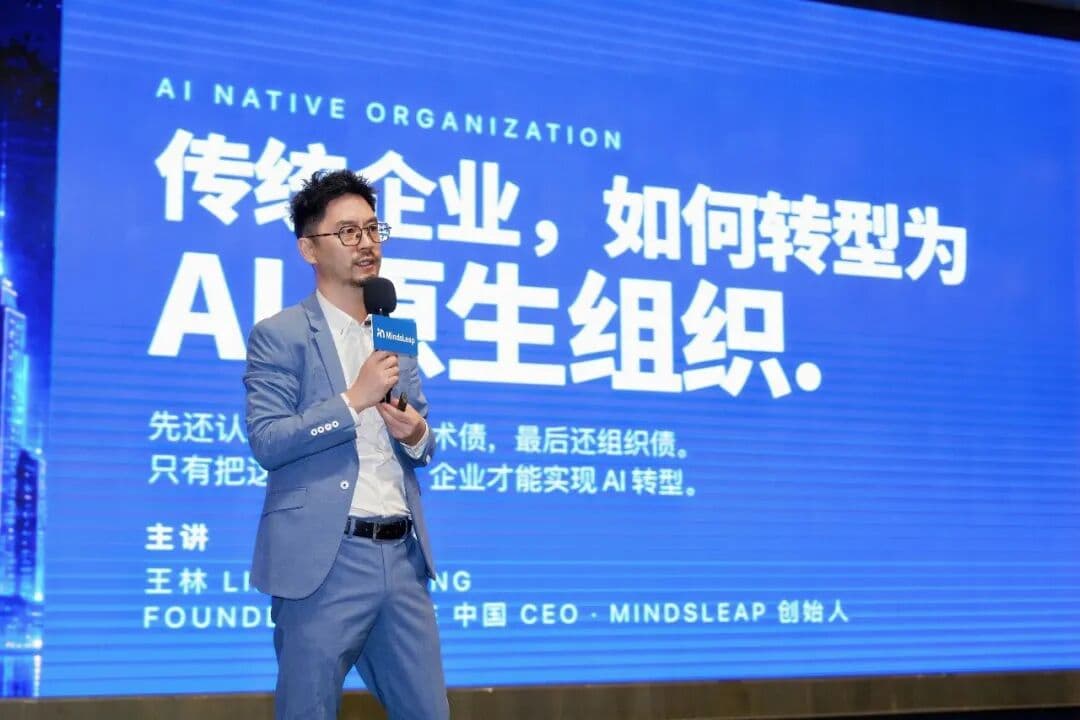
At the AI Native Enterprise Conference, Lincoln Wang, CEO of Founders Space China and founder of MindsLeap, gave a talk for traditional entrepreneurs around one practical question:
How can traditional companies transform into AI-native organizations?
His talk did not begin with how to use a model. It began with why most traditional companies struggle to truly transform. Lincoln's central point was that AI transformation cannot be reduced to tool procurement or a few training sessions. Companies must rethink the logic of work, memory, collaboration, and organizational rhythm.
Start by admitting the reality
Lincoln began with a sober observation: everyone is talking about AI transformation, but there are still relatively few large-scale traditional enterprise cases that have fully succeeded.
That does not mean companies should wait. It means they need to reason from first principles: which capabilities can already be built, which parts of the organization need to change, and which debts must be repaid before real transformation can happen.
The purpose of the talk was not to provide a template for companies to copy. It was to provide a framework for judgment.
Three debts: cognition, technology, and organization
Lincoln described three forms of debt that traditional companies must repay: cognitive debt, technical debt, and organizational debt.
Cognitive debt means that leadership teams still understand AI only on the surface. Terms such as token, agent, skill, workflow, and memory may sound like technical jargon, but if a company wants to become AI-native, it must understand which business actions these concepts correspond to and how they combine into real workflows.
He emphasized one line:
You can outsource your thinking, but you cannot outsource your understanding.
AI can help generate plans, but it cannot complete understanding on behalf of the organization. Without understanding, transformation cannot really happen.
Technical debt is not only about whether a company has connected to a model. It is about whether the team has truly used AI in real work, built internal experimentation mechanisms, and connected AI into actual processes. Many companies attend courses, buy tools, and run workshops, but when implementation begins, they fall back into old working methods.
Organizational debt is the hardest layer. The biggest blocker is often not technology, but the reluctance to adjust structure: how performance evaluation changes, how departments are re-divided, who keeps judgment, which processes move to AI, and which roles need to be redefined.
If these questions are not touched, a company may use many AI tools while remaining a traditional organization.
The difference is not only speed
Lincoln used a simple example: if a company needs to run an online campaign, a traditional organization may first prepare a plan, find vendors, make a budget, and move through familiar procedures.
In the AI era, the final deliverables may still be an event plan, posters, slides, content, and screens. But the production process can be completely different. Many intermediate steps can be handled by AI, many outputs can be templated and turned into assets, and the same process can be reused the next time.
That means the difference between a traditional organization and an AI-native organization is not only whether work becomes faster.
A traditional organization completes tasks. An AI-native organization builds reusable systems.
This is why companies should not only ask whether a project was completed. They should ask whether the project left behind reusable workflows, memory, and assets.
The building blocks of organization are being rewritten
Lincoln argued that while organizational structures do not need to be entirely discarded, the content inside them must be rewritten for the AI era.
First is People. In the past, people were the primary actors inside organizations. In the AI era, there is a new working entity: agents, digital employees, and intelligent systems. Organizational design can no longer ask only how many people are needed. It must ask how many people, how many agents, and how they should work together.
Second is Work. Traditional work often moves sequentially from one person or department to another. Copy goes to design, design goes to marketing, and marketing continues the process. In the AI era, many forms of work can become automated workflows. Companies are no longer just managing tasks. They are managing the design, triggering, connection, and monitoring of workflows.
Third is Memory. In many companies, experience lives in employees' heads. When people leave, the organization loses continuity. AI-native organizations need to rebuild memory: how individual workflows are captured, how organizational knowledge is structured, and which forms of memory can be called by agents.
Fourth is Structure. Human work is sequential, limited, and relatively slow. AI can run many tasks in parallel. Structures designed around human rhythm may not be able to absorb AI's rhythm. This affects decision speed, collaboration patterns, responsibility boundaries, and monitoring mechanisms.
Employees and AI cannot stand on opposite sides
Lincoln also addressed a practical tension in organizational transformation. Founders and CEOs often want to push AI because they see the results it can create. Employees may not feel the same way. They may view AI as an opponent.
That can create a familiar pattern: the CEO wants to push AI forward, while employees try to prove that AI does not work. Behind this is a real concern that if AI works, the employee's position may be affected.
For that reason, companies cannot only connect technology. They must design culture and incentives so that employees and AI stand on the same side of the table. This involves incentives, role definition, collaboration design, and ways to share risk.
From AI in the loop to people on the loop
Lincoln described three stages in the evolution toward AI-native organizations.
The first stage is AI in the loop. Human workflows remain the main line, and AI is inserted into specific points as assistance. This is where most companies are today.
The second stage is People in the loop. AI workflows begin to drive the process, while humans step in at key moments to correct, judge, and control. The process is mainly driven by AI, while people handle key checkpoints.
The third stage is People on the loop. Humans gradually move from process participants to process supervisors. They set goals, define rules, establish boundaries, and monitor outcomes.
The essence of this path is a shift from putting AI into old processes to redesigning the organization around AI workflows.
A practical reminder for traditional companies
Lincoln's talk can be summarized into a few practical reminders:
- Do not treat AI transformation as a procurement project.
- Do not keep AI understanding at the level of buzzwords.
- Do not avoid changes to structure and performance systems.
- Include workflows, memory, and agents in organizational design.
- Put employees and AI on the same side, not in opposition.
The real value of Lincoln's talk was not that it promised companies an instant path to transformation. It clarified a question that is often ignored:
A true AI-native organization is not an old organization with an AI layer on top. It is an organization whose work logic, memory mechanisms, collaboration patterns, and rhythm have begun to change.
MindsLeap x Founders Space will continue to host frontier AI conferences, practical AI workshops, and AI hackathons for entrepreneurs, helping business leaders turn AI cognition into real action.
Source Note
This article was adapted from the Founders Space official WeChat article Lincoln|Founders Space 中国 CEO 分享回顾, published on May 25, 2026.
About MindsLeap
MindsLeap is an enterprise AI transformation and AI-native startup acceleration platform. Through the MindsLeap Founders AI Club, AI training and strategic advisory, FDE implementation, startup acceleration, and global growth services, MindsLeap helps traditional enterprises embed AI into real business workflows and helps AI-native ventures connect with industry use cases and global markets. MindsLeap is a global partner of Founders Space.
This article was translated and adapted from the Chinese original with AI assistance.