Author: Lincoln Wang | Founder & CEO, MindsLeap | Partner and CEO, Founders Space China | Founder, MindsLeap Founders AI Club
One Sentence That Changed the Data Center Business Model
"In the past, data centers were where you spent money. AI factories are where you make money."
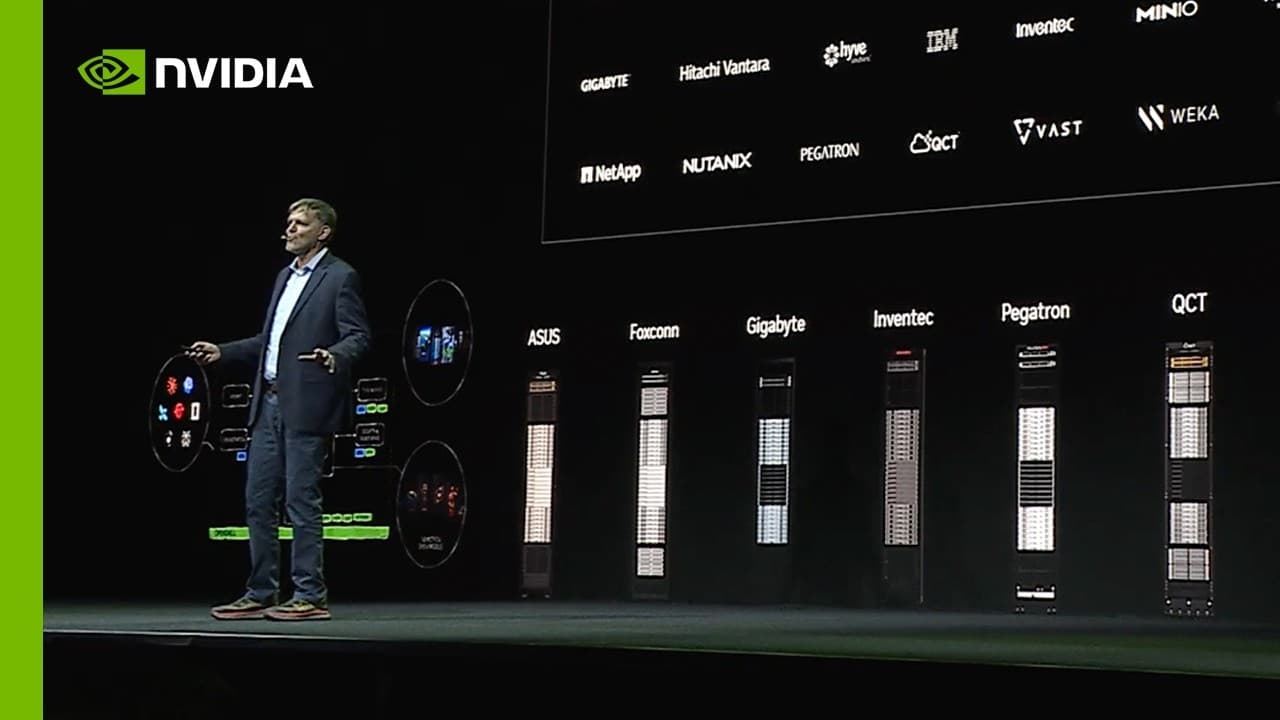
Kevin Darling said this on stage just as someone in the audience flicked a green laser pointer dot across his slide. He smiled, said "Taiwan friends are really friendly," and kept going.
This was Computex 2026 in Taipei. Darling is Senior Vice President of NVIDIA's Networking business. Six years ago, NVIDIA acquired the networking company he worked at. He says Jensen told them back then to "optimize across the entire data center stack." He admits he thought it sounded cool at the time but didn't know what it meant. Six years later, he stood on stage delivering an entire keynote to explain what those words truly meant.
The meaning is far more radical than most people realize.
NVIDIA isn't upgrading data centers — it's fundamentally redefining what "infrastructure" is. Traditional data centers are cost centers: machines running applications, the place you frown at when the monthly bill arrives. The AI factory logic is completely different — its output is tokens, tokens are revenue, and the entire factory has one design goal: produce more tokens at the lowest cost and highest efficiency.
This isn't a technology iteration. It's a business logic replacement.
Moore's Law Is Dead, But Demand Is Pulling Vertically
To understand why this is so urgent, you need to accept an uncomfortable fact first.
Darling said it plainly on stage: Moore's Law is dead. More precisely, Moore's Law promised not just "transistor count doubles every two years" — it promised this would happen at the same power consumption and the same cost. That promise broke down in 2005. It's been twenty years.
Meanwhile, AI's demand for compute hasn't slowed — it's accelerating. Model parameter counts grow 10x per year, and that curve continues. More troubling, token consumption during inference is also exploding. About eighteen months ago, the emergence of Mixture-of-Experts (MoE) models brought an inflection point — AI started generating hundreds of internal reasoning tokens for every single output token. This means the growth rate of compute demand is far steeper than most people perceive.
The physics on the supply side has broken down, while demand on the other side keeps pulling vertically. That's why NVIDIA says it's "running like crazy," and why they need to redesign every layer of the data center from scratch.
What a Reservoir Taught NVIDIA
Darling used an unexpected analogy in his talk.
He showed a chart of Taipei's monthly rainfall over the years, pointing out that rain isn't evenly distributed — some months have downpours, others have almost none. That's why humans built dams, he said — the Feicui Reservoir on Taipei's outskirts works the same way: store water during the wet season, release it during the dry season, make the most of a scarce resource.
Then he said the power consumption curve of AI training looks almost identical to that rainfall chart.
Traditional cloud computing workloads are flat — requests from countless random users叠加 together, ultimately presenting as a smooth, steady line. AI training is completely different. Tens of thousands of GPUs operating as one unified machine — computing, synchronizing weights, computing again — this rhythm produces violent power consumption peaks and valleys.
Power companies are not happy. They say: "You're consuming massive amounts of power, then suddenly stopping. You're damaging our transformers."
NVIDIA's solution is DSX, which Jensen called the "operating system" for AI factories in his GTC keynote. It stores energy in capacitors and power systems during low-consumption periods and releases it during peaks, flattening the entire factory's energy consumption curve. The result: with the same power budget, you can deploy 40% more GPUs.
"40% more GPUs means 40% more tokens, which also means 40% more revenue."
Darling said this himself. Energy management isn't ESG, isn't a "green data center" gimmick — it's a compute multiplier, a revenue multiplier. Understanding this is the entry point to understanding AI factory logic.
Seven Chips and "Use Copper Where You Can"
NVIDIA is now designing seven chips simultaneously. They're not independent products — they're a co-designed system.
The Rubin GPU and Vera CPU are tightly coupled through high-performance cache coherency links, expanded at the rack level with NVLink, and connected at the data center level with the Spectrum-X network fabric. The entire design has one goal: make 72 GPUs behave like a single computer, like one unified machine. Darling says this "extreme co-design" delivers 10x token throughput improvement and one-tenth the per-token cost.
Darling also mentioned a detail — one of Jensen's principles: use copper where you can. Copper cables are cheap, reliable, and don't consume power, but the problem is that the faster the speed, the shorter the distance copper can effectively transmit. At current rates, copper only works within a few meters inside a rack. Once you need cross-rack connections, you must use fiber.
But even with fiber, there are nuances. Darling explained that signals come out of the chip "beautiful," but after traveling through PCB traces to the optical transceiver front end, the signal becomes "ugly." The traditional approach is to reshape the signal before driving the fiber — a process that itself consumes energy.
NVIDIA's Spectrum CPO (Co-Packaged Optics) switches integrate optical devices directly inside the chip package. The signal enters the fiber immediately upon leaving the chip, eliminating that loss stage. The result: an AI factory can save tens of megawatts of power. That power can be used to run more GPUs and generate more tokens.
"Agents Are AI Eating Its Own Tail"
The densest section of the talk was when Darling discussed AI agents.
His definition was direct: "Agents are AI eating its own tail. It's no longer humans generating prompts — AI closes the loop, giving itself prompts."
This "eating its own tail" metaphor clarifies something many people haven't fully grasped: AI agents aren't just "smarter chatbots." They represent a topological change. Past AI was human-machine dialogue — question and answer, with humans in the loop. The agent architecture is AI-to-AI high-speed dialogue, where humans exit the real-time loop and only intervene at the start and end of tasks.
"Humans are slow. AI is fast. AI has no patience."
This isn't praising AI — it's an engineering constraint: when agents communicate at high speed, network bandwidth becomes the bottleneck. NVIDIA's current ConnectX and BlueField already operate at 800 Gbps and are migrating toward 1600 Gbps, driven precisely by agent bandwidth demands.
Darling also mentioned that AI agents need two types of memory: short-term memory (KV cache) and long-term memory (files, object storage, vector databases). NVIDIA developed a new storage reference architecture for this, using CMX for KV cache and STX for long-term memory, achieving 5x token throughput improvement and 5x efficiency gains.
The Vera CPU plays an equally important role in this architecture. Darling says Vera is a CPU built specifically for agent workloads — it plans tasks, writes programs, aggregates results, compresses context. This is completely different from past CPUs, which fed data to GPUs. Now the CPU does the "mental labor" for AI agents.
Darling closed with a line I think deserves to stand alone:
"Agents eat tokens for breakfast, lunch, and dinner."
This isn't rhetoric. It's another inflection point warning for the compute demand curve.
Who Pays This Bill
A core metric recurred throughout the talk: how many tokens per watt, how many tokens per dollar.
This is NVIDIA's internal North Star and the standard they use to examine every design decision. Why liquid cooling? Because you can pack GPUs denser, copper cables don't need to be as long. Why co-packaged optics? Because saving tens of megawatts converts to more tokens. Why energy smoothing? Because the same power budget can deploy 40% more GPUs. Every decision serves the same goal: drive down per-token cost.
Darling casually mentioned one data point: DeepSeek models achieved a 30x performance improvement on the Blackwell architecture. He only said it in passing, but it illustrates something — co-optimization between models and chips can already produce an order-of-magnitude efficiency gap, not a few percentage points of improvement. That gap will ultimately show up in service pricing, in whether you can run a model cheaper than competitors, respond to a request faster, or more economically support a fleet of AI agents.
For enterprise decision-makers, there's a line in Darling's talk that's easy to dismiss as a slogan: "Every enterprise should be using AI agents because it makes your human employees more productive — far more productive than you'd imagine."
I'd be more cautious. Not every enterprise is ready to deploy AI agents directly today, but every enterprise leader should answer a more specific question: in my business processes, which steps are humans performing repetitive judgments that could run in high-speed loops? Those are the places where AI agents will intervene first.
Not because AI is smarter — but because AI doesn't need rest, AI has no patience, AI keeps running while you sleep.
The world is building factories that produce tokens, not data centers that burn electricity. People who understand this difference and people who don't will find themselves in very different positions over the next few years.
About MindsLeap
MindsLeap is an AI-native enterprise transformation accelerator.
We partner closely with Founders Space, the Silicon Valley innovation incubator, to continuously connect cutting-edge global AI knowledge, the Silicon Valley tech startup ecosystem, and the real-world transformation challenges facing Chinese entrepreneurs.
Around the theme of AI-native organization building, MindsLeap is constructing an ecosystem for entrepreneurs, startup founders, AI engineers, industry experts, and investors — helping enterprises move AI from awareness, strategy, and tools into real organizational capabilities, business processes, product innovation, and growth systems.
This article was translated and adapted from the Chinese original with AI assistance.