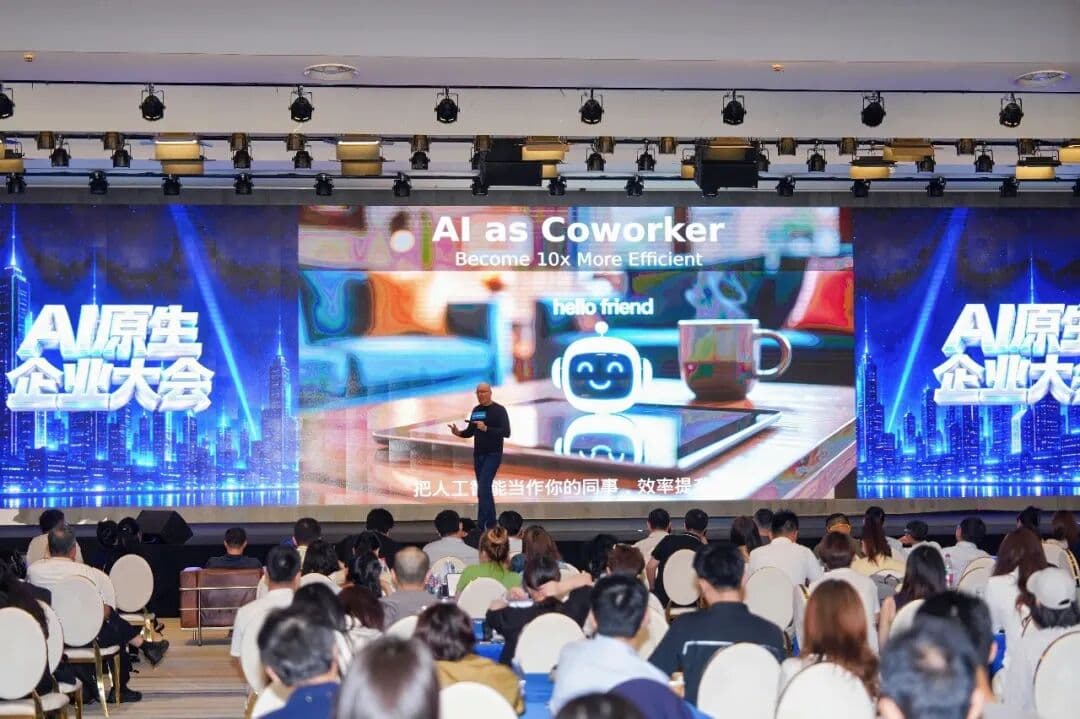
At the AI Native Enterprise Conference, Steve Hoffman, founder of Founders Space and a leading Silicon Valley innovation advisor, delivered two talks for entrepreneurs around one central question:
How can companies truly put AI into business workflows and become AI-native?
Hoffman's talks did not stay at the level of which tools to use. He focused on AI's role inside the organization, the right order of deployment, AI leadership, automation infrastructure, feedback loops, and data boundaries. His central point was clear: the key to becoming AI-native is not how many models or agents a company connects. It is whether AI is connected to the workflows that actually create value.
The first step is not buying tools
Hoffman began by reminding companies that AI should not be treated as a tool that employees occasionally open. It should become a long-term partner inside the company's operating system.
Many companies still use AI only at the surface level: researching information, asking questions, generating content, or assisting with isolated tasks. A truly AI-native company brings AI into deeper business contexts, including opportunity evaluation, strategy discussions, customer simulation, copy and product critique, data analysis, and market research.
In other words, AI is not a separate toolbox. It becomes part of the company's operating, decision-making, and feedback systems. Its value is not only saving a few minutes. It expands the team's range of thinking, accelerates experimentation, and lowers the cost of high-quality research and judgment.
AI projects often fail because the order is wrong
Hoffman noted that many AI projects fail not because AI is weak, but because companies deploy it in the wrong order.
One common mistake is to put AI directly in front of customers too early: in sales, support, or other zero-error environments. Hoffman's advice is the opposite. Companies should begin with back-office workflows, where internal employees can supervise, correct, and evaluate AI output before the system moves into higher-risk contexts.
This is not about lowering ambition. It is about increasing the odds of success. Companies need to identify reliable scenarios, define output standards, reduce error rates, and observe real changes in workflows before expanding AI into higher-leverage positions.
A second common mistake is removing humans too early. Hoffman emphasized that AI can make mistakes and hallucinate. More importantly, it does not automatically know what a good outcome means for a specific business. Until AI truly understands the business context, humans must remain in the loop to supervise, correct, define standards, and provide feedback.
A third mistake is deploying too many agents at once. New tools, platforms, and frameworks appear every day, and companies can easily be pulled along by the market. Hoffman's recommendation is to choose one or two agents that genuinely fit the business, stabilize the results, and expand gradually.
AI leadership is a management practice
Hoffman's definition of AI leadership was practical. It is not a slogan about embracing AI. It is a set of management actions that leaders must take consistently.
First, leaders need to explain why AI matters. Employees may not naturally support AI. They may worry about job displacement, or they may feel that AI is difficult to use and often wrong. Leadership needs to show, through real cases, why AI matters, how it changes work, and how it can make people more effective.
Second, AI cannot remain only an initiative. If AI does not enter goals, performance systems, incentives, and evaluation, employees are unlikely to adopt it deeply. Adoption is not only a cultural issue. It is also a system design issue.
Third, leaders must use AI themselves. Hoffman warned that if leaders do not use AI but ask the organization to adopt it, trust is hard to build. Employees infer importance from leadership behavior: whether this is truly important, whether the company will invest in it long term, and whether leaders believe in the method.
Finally, companies need to identify internal AI champions. In almost every organization, there are people who like experimenting with new tools and workflows. Giving them time, recognition, and channels to share what they learn can create more real change than a one-time training session.
Five pillars of the AI-native enterprise
In his second talk, Hoffman broke the AI-native enterprise into five pillars.
The first pillar is Agents. Companies should use agents not to chase a trend, but to make sales, acquisition, content, support, and other functions more automated, coordinated, and scalable. The important questions are where the agent sits, how it collaborates, and who takes over when the agent completes its task.
The second pillar is Automation infrastructure. Without automation infrastructure, agents remain scattered tools. Companies need tool connections, triggers, data flows, and workflow infrastructure. Only when these foundations are in place can AI take over part of the business process.
The third pillar is AI-generated revenue. Hoffman was not only talking about using AI to save cost. He was asking whether AI can directly generate revenue. Can products be produced or delivered by AI? Can services be operated by AI? Can revenue gradually become less dependent on human labor hours? This is one of the key differences between traditional companies and AI-native companies.
The fourth pillar is Feedback loops and monitoring. AI does not know what the company considers a good outcome. Companies must build mechanisms for correction, feedback, monitoring, and iteration. The stronger the feedback loop, the more valuable AI becomes inside the organization.
The fifth pillar is Distribution and compounding assets. Hoffman encouraged companies not to focus only on short-term efficiency. They should ask what content, data, systems, and workflows will become more valuable over time as they are used.
People and revenue will be redefined
Hoffman also emphasized that AI-native enterprises will reshape the relationship between people and revenue.
In the past, revenue growth usually meant hiring more people, delivering more work, adding more hours, and expanding more operational lines. Revenue growth was tightly tied to headcount and labor hours. In AI-native businesses, revenue has the potential to become less linearly tied to human labor. Smaller teams may be able to support much larger business scale through AI workflows and automation systems.
That also changes the role of people. Hoffman summarized it in one line:
You are the architect of the system, not the operator of the task.
The most valuable people in the future may not be those who manually complete every task. They may be those who set goals, design systems, orchestrate agents, and correct output.
Move boldly, but set clear data boundaries
During the Q&A, Hoffman also addressed data security. His view was not that companies should avoid AI because risk exists. His view was that companies need to use AI more maturely.
When sensitive customer data is involved, companies should consider private or dedicated systems, define what data customers allow to be shared, abstract sensitive information before asking models for help, and keep human review in critical workflows.
This is part of AI-native maturity: companies must know where AI can be allowed to operate freely, where boundaries are required, and where human oversight must remain.
What entrepreneurs should take away
Hoffman's talks can be condensed into five practical reminders:
- Upgrade AI from a tool to an operating partner.
- Start with back-office workflows before putting AI in front of customers.
- Do not remove humans from the loop too early.
- Connect AI adoption to incentives, performance, and leadership behavior.
- Rebuild the company around agents, automation infrastructure, feedback loops, and compounding assets.
The most important point in Hoffman's sharing was not a list of recommended platforms. It was a deeper judgment:
An AI-native enterprise is not a company that simply uses a lot of AI. It is a company that connects AI to core workflows, then uses those workflows to create value, accumulate assets, and amplify organizational capability.
MindsLeap x Founders Space will continue to host frontier AI conferences, practical AI workshops, and AI hackathons for entrepreneurs, helping business leaders turn AI cognition into real action.
Source Note
This article was adapted from the Founders Space official WeChat article Steve Hoffman |硅谷创投教父分享回顾, published on May 25, 2026.
About MindsLeap
MindsLeap is an enterprise AI transformation and AI-native startup acceleration platform. Through the MindsLeap Founders AI Club, AI training and strategic advisory, FDE implementation, startup acceleration, and global growth services, MindsLeap helps traditional enterprises embed AI into real business workflows and helps AI-native ventures connect with industry use cases and global markets. MindsLeap is a global partner of Founders Space.
This article was translated and adapted from the Chinese original with AI assistance.